
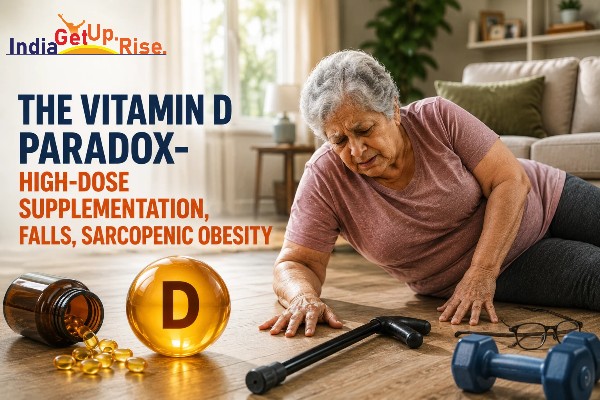
The regular view of Vitamin D as a simple remedy for age-related illnesses has persisted for a long time. However, new trials have revealed that more Vitamin D may not always be better.
The phenomenon of too much Vitamin D causing unwanted outcomes is now referred as the Vitamin D Paradox. While it is still important to address that too much supplementation may actually make someone at higher risk for falling or fracturing due to Vitamin D.
When More Is Not Better: Landmark High-Dose Trials
To see if taking higher doses of Vitamin D would lower frailty and fall risk, researchers have conducted several large randomized controlled trials.
The Sanders Annual 500,000 IU Trial
In one landmark study published in JAMA, Dr. Kerrie M. Sanders and her coworkers evaluated the long-term effects of taking high doses of Vitamin D through a 500,000 IU of Vitamin D suspended in oil once a year for 5 years for 2,256 women aged 70 or more in the community and followed them for 5 years.
Key Findings
- The high dose group had a higher number of falls compared to the low dose group.
- The high dose group exhibited a higher rate of fractures compared to the low dose group.
- The high dose group manifested the highest rate of fractures during the first 3 months after starting the high dose Vitamin D supplementation.
The Bischoff-Ferrari Monthly 60,000 IU Trial
Dr Heike Bischoff-Ferrari studied older people taking different doses of Vitamin D – up to 60,000 IU / month, and his findings were published in JAMA Internal Medicine.
Key Findings
In comparison to standard-dose participants, the findings showed that people taking higher doses had:
- Higher rates of falling than standard-dose participants
- No significant increases to lower extremity function
- No meaningful differences in physical performance
Taken together, this research shows a U-shaped relationship between Vitamin D deficiency or too much Vitamin D, leading to worsening outcomes.
Why Might Excess Vitamin D Increase Falls?
Vitamin D is crucial for maintaining normal calcium levels and affecting the coordination of the muscles and nerves.
By amending a deficiency, you help to preserve fast twitch fibre, however, giving very large intermittent doses of Vitamin D will create drastic changes in physiology that will disrupt normal calcium signalling and neuromuscular control.
Therefore, rather than helping to improve balance, the drastic change will temporarily decrease balance, which likely explains why in the clinical trials a higher percentage of people fell.
The Double Threat of Sarcopenic Obesity
What complicates matters further are individuals who have sarcopenic obesity (i.e., loss of muscle in combination with excess body fat) because their metabolism for Vitamin D is more problematic.
Excess fat can be an issue with respect to trying to absorb vitamin D because of the way vitamin D is stored in the body as a fat-soluble vitamin. One way that this happens is through a process called volumetric sequestration. This states that some of the vitamin D from the diet may end up in the fat instead of in your muscle tissue because you have too much excess body fat in relation to your overall size.
Numerous studies states that there is an opposite relationship between body fat percentage and 25-hydroxyvitamin D (25(OH)D) levels in the blood.
Another problem caused by sarcopenic obesity is that it can cause myosteatosis, which is when fat builds up in muscle tissue causing inflammation and also promoting loss of muscle tissue. There are two specific inflammatory markers, Interleukin 6 (IL-6) and C-Reactive Protein (CRP), which have been shown to promote muscle degradation and worsen functionality.
Clinical Implications
The evidence stated that we need to continue correcting vitamin D deficiencies in individuals whose levels of serum 25(OH)D are below 20 ng/ml (50nmol/mol).
There is no evidence to support that high doses of vitamin D supplementation can offer improved health benefits over lower doses and that there is a risk of falling when using high doses of Vitamin D.
Now, as we’re trying to help the elderly maintain their muscle mass with sarcopenic obesity, we must keep in mind that giving someone a supplement alone is not going to be enough of a treatment.
Conclusion
Some studies have shown that patients receiving 500,000 IU/year (e.g., very high doses of Vitamin D) or 60,000 IU/month are still at risk for falls and fractures because of the use of excessive Vitamin D.
Therefore, rather than simply increasing the amount of Vitamin D that people take, the goal should be to ensure that people receive adequate amounts of Vitamin D.
In addition, to ensure that individuals do not have low-levels of Vitamin D, it is critical to provide adequate protein, as well as appropriate levels of physical activity to enable individuals to maintain strength, mobility, and independence as they age.
The goal is not to achieve the highest Vitamin D level possible, but to maintain adequate levels while supporting muscle health through proper nutrition, healthy body composition, and regular resistance exercise.
References
- Sanders KM, et al. Annual High-Dose Oral Vitamin D and Falls and Fractures in Older Women. JAMA 2010.
- Bischoff-Ferrari HA, et al. Monthly High-Dose Vitamin D Treatment for the Prevention of Functional Decline. JAMA Internal Medicine 2016.
- Endocrine Society. Clinical Practice Guidelines: Vitamin D for the Prevention of Disease. 2024.
- EWGSOP2. Sarcopenia: Revised European Consensus on Definition and Diagnosis. Age and Ageing 2019.
- Bauer JM, et al. (PROT-AGE Study Group) Evidence-Based Recommendations for dietary protein requirements for the Older People. JAMDA 2013.