
Research no longer supports a single, easy-to-use treatment for age-related loss of skeletal muscle. High-volume trials conducted recently—VITAL (Vitamin D and Omega-3 Trial) and D-Health (Vitamin D to Prevent Falls) trials—showed that adults with sufficient baseline levels of vitamin D do not significantly improve their muscle mass or grip strength and do not prevent sarcopenia by taking vitamin D by itself.
Why Vitamin D Alone Is Not Enough
As we age, our skeletal muscles become less responsive to normal nutritional and hormonal triggers and develop anabolic resistance. Vitamin D plays an essential role in binding with vitamin D receptors (VDR) located in the muscle cells and supporting the biological pathways associated with muscle protein synthesis (i.e., converting amino acids to muscle), neuromuscular transmission (i.e., making muscle work via signals), and regulating calcium concentrations in the muscle cell.
Protein: The Building Material for Muscle
As a result, due to anabolic resistance, the RDA for protein at 0.8 g/kg/day (for the average person), is often insufficient for older adults.
To create an adequate amount of protein for older adults of all ages, the PROT-AGE Study Group developed healthy recommendations for older adults regarding the amount of protein they need in collaboration with the European Society for Clinical Nutrition and Metabolism (ESPEN).
PROT-AGE Recommendations
- 1.2-1.5 g/kg/day of protein for sarcopenic preclusion and healthy muscle maintenance.
- Up to 2.0 g/kg/day for older adults with acute or chronic illness.
- An average of 25-30 g of protein per meal, with approximately 3 g of leucine (an amino acid used for the mTORC1 pathway stimulation) per meal.
If protein intake is insufficient, the body will not have enough raw materials to repair and develop muscle tissue.
Exercise: The Signal for Growth
Exercise serves as a signal to the body to use protein—as the body has no idea where to use protein unless told so by exercise. As a result, research consistently demonstrates that Progressive Resistance Exercise (PRE) is the most effective means for countering sarcopenia.
Microscopic damage occurs to muscle fibres during weight training, resistance-band exercises, or any other type of movement that provides resistance in order to perform exercises using bodyweight. The mechanical stresses triggered by progressive resistance training lead to two significant physiological processes:
- The stimulation of muscle re-modelling
- The suppression of myostatin—an intra-muscle protein that inhibits muscle development
- Activation of the body’s muscle repair pathways
- Increased strength and hypertrophy of muscle tissues
Evidence of Synergy: Lessons from DO-HEALTH
The following investigation provides a significant piece of information that supports the above, which is the European DO-HEALTH Trial, conducted by principal investigator Dr. Heike Bischoff-Ferrari.
This study enrolled 2,157 individuals ≥ 70 years of age from five European countries and provided participants with a daily dose of 2,000 IU of Vitamin D₃ for three years, and it was determined that while the use of Vitamin D alone produced no significant improvements in physical performance (walking, muscle power, and general physical function), secondary analysis showed an observation that improved outcomes for the use of Vitamin D and structured exercise and nutrition yielded improved outcomes from the exercise and overall nutrition when combined.
This indicates that Vitamin D may maximize the potential for muscular health (muscle repair, muscle strength (hypertrophy), etc.); however, Vitamin D combined with both adequate nutrition and regular exercise is most likely to provide clinically significant improvement in this area after treatment completion.
Clinical Implications
Vitamin D is still vital for people who have low levels of 25(OH)D in their blood (<20 ng/mL or 50 nmol/L). However, simply boosting Vitamin D Levels will not maintain muscle strength or function – there are multiple biological pathways that must be addressed concurrently.
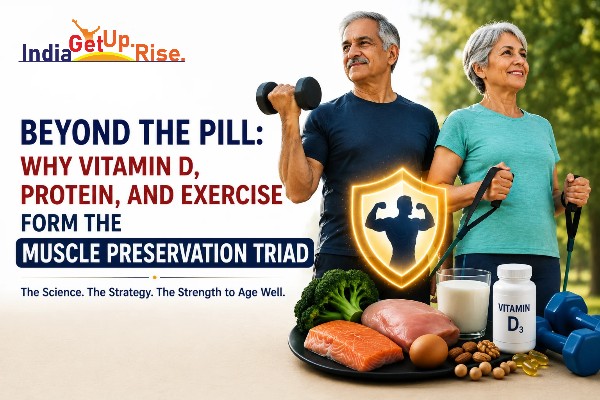
The Muscle Preservation Triad outlines this approach and has three parts:
- Ensure you have enough Vitamin D Levels.
- Consume 1.2 to 1.5 grams of protein per kilogram of body weight daily (or more as needed based on justification).
- Engage in progressive resistance training as a regular activity.
When these three interventions are completed together, they can affect muscle biology from different perspectives, therefore providing greater protection against age-related decline of muscle strength and function.
Conclusion
The most current body of research demonstrates a change in the message of “one miracle supplement” for improving health during the aging process to an integrated strategy for achieving successful aging.
Vitamin D continues to be a necessary component of maintaining muscle health but it will not prevent or treat sarcopenia on its own. Recommendations of the PROT-AGE Study Group and data from the DO-HEALTH studies have emphasized that there is much more to promoting and maintaining muscle health than simply taking Vitamin D. Adequate levels of Vitamin D, adequate protein intake (higher quality), and regular resistance training must all work in harmony to preserve strength, mobility, and independence as a person ages.
In summary, retaining strength, mobility, and independence as we age involves taking action beyond just taking a pill. While Vitamin D may be beneficial in preparing the system for muscle health, protein will provide the necessary building blocks and exercise will provide the necessary stimulus to continue to promote muscle health as we age.
The future of healthy aging lies not in a single supplement, but in the combined power of Vitamin D, protein, and exercise working together to preserve muscle strength and independence.
References
- Bauer JM, et al. (PROT-AGE Study Group). Evidence-Based Recommendations for Optimal Dietary Protein Intake in Older People. JAMDA. 2013.
- Bischoff-Ferrari HA, et al. The DO-HEALTH Randomized Clinical Trial. JAMA. 2020.
- Deutz NE, et al. (ESPEN). Protein Intake and Exercise for Optimal Muscle Function with Aging. Clinical Nutrition. 2014.
- EWGSOP2. Sarcopenia: Revised European Consensus on Definition and Diagnosis. Age and Ageing. 2019.