
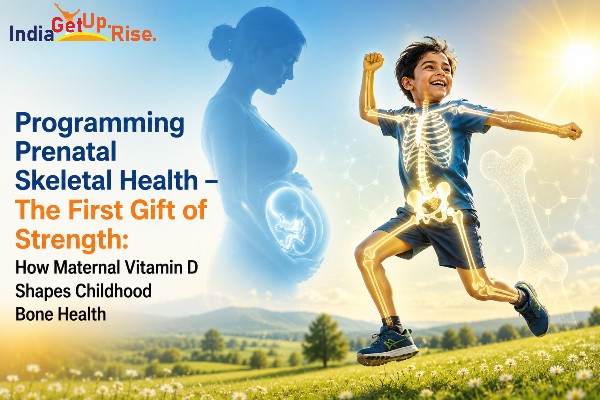
The development of a child’s bones begins long before they take their first steps, with the fetal skeleton rapidly developing and relying completely on the mother’s minerals for the development of the strong bone structure.
While the childhood bone health of children is thought to be linked to their diet and exercise after birth, the developing of skeletal strength may actually start long before a baby is born. Vitamin D3 is critical in the processes involved in human bone growth and regulation of calcium absorption and mineralization. There is a growing body of evidence showing maternal vitamin D3 levels may affect childhood bone density, skeletal development, and risk for fracture.
The Biological Connection
Building Bones Before Birth
The 3rd trimester is characterized as being a critical time for fetal bone mineralization, as a lot of calcium is transferred to the growing skeleton through the placental wall.
Maternal Vitamin D3 → Placental Calcium Transfer → Fetal Bone Mineralization → Childhood Bone Strength
The Vitamin D Receptor (VDR) is located within the developing bone and placental tissue. Adequate amounts of maternal Vitamin D3 supports calcium and phosphate transportation and regulates the osteoblasts that form bone, therefore supporting the healthy skeletal development prior to delivery.
Clinical Studies: Evidence
The MAVIDOS Study
The MAVIDOS Trial was a double-blind, placebo-controlled study that looked at the effect of vitamin D supplementation on bone mass at 4 years in children born to vitamin D supplemented mothers compared to placebo mothers, in a UK Cohort.
Pregnant women between 25 and 100nmol/L of 25 hydroxyvitamin D (25OHD) were randomized to take 1000IU/day vitamin D3 or placebo from between 14 and 17 weeks gestation until delivery. Patterns of Whole Body Less Head aBMD throughout age were found to be increased in infants whose mother took vitamin D3 from the first trimester of pregnancy to delivery compared to placebo mothers at age 4 years.
When evaluated at six to seven years of age after the children were born, the positive effects of maternal Vitamin D on skeletal development continued.
Children received the following measured outcomes:
- WBLH bone mineral content: +0.15 SD (95% CI: 0.04–0.26)
- WBLH bone mineral density: +0.18 SD (95% CI: 0.06–0.31)
- WBLH bone mineral apparent density: +0.18 SD (95% CI: 0.04–0.32)
- Lean tissue mass: +0.09 SD (95% CI: 0.00–0.17)
Based on these studies, those who received Vitamin D while pregnant may have positively impacted their child’s skeletal development well beyond delivery.
The COPSAC2010 Study
The Danish COPSAC2010 study assessed whether higher doses of vitamin D will have an effect on maternal supplementation of prenatal supplementation of vitamin D.
Women received either 2,800 IU/day of Vitamin D3 or 400 IU/day of Vitamin D3 starting at 24 weeks gestation.
MAVIDOS and COPSAC2010 research data demonstrate that if a mother has good maternal Vitamin D, her children will have higher levels of bone mineral density than if their mother had low maternal Vitamin D, specifically for children whose mothers had low baseline levels of maternal Vitamin D.
Adequate maternal Vitamin D at 6 months of age and a mother’s use of high dose prenatal Vitamin D supplements significantly reduce the risk of fracture in children.
For the children studied, fracture risk was found to have a 60% lower incidence with an Incidence Rate Ratio of 0.40 (95%CI: 0.19 – 0.84; P=0.02).
Why This Matters
MAVIDOS and COPSAC2010 studies confirm that maternal Vitamin D levels during pregnancy are critically important.
While Vitamin D is only one element of lifelong skeletal health, MAVIDOS and COPSAC2010 studies now indicate that higher maternal Vitamin D supplementation could provide added benefits above and beyond what is typically used for supplementation.
MAVIDOS and COPSAC2010 studies add to the body of evidence and data that maternal Vitamin D levels should be monitored and maternal Vitamin D Should be Adequate Throughout Pregnancy.
For Innovators in the Pharmaceutical Industry, MAVIDOS and COPSAC2010 studies provide additional data that supports the development of prenatal formulations based on evidence to improve maternal nutrient status and promote healthy fetal skeletal development.
Conclusion
The foundation for strong bones starts much earlier than the childhood years. Studies conducted by MAVIDOS and COPSAC2010 provide additional evidence that maternal Vitamin D levels during pregnancy can impact the mineral content of the fetal skeleton, bone density during childhood, and risk of bone fracture throughout life. Although Vitamin D is not the only factor affecting one’s bone health, the findings of these studies demonstrate how nutrition during pregnancy can affect bone development for the rest of one’s life.
The first gift of strength begins before birth.
References
- Mabrouk, Moon RJ, et al. Vitamin D Supplementation During Pregnancy and Childhood Bone Mineral Density at Age 4 Years: Follow-up of a Randomized Controlled Trial. Am J Clin Nut. 2023.
- Harvey NC, et al. Low-Dose Vitamin D Supplementation in Pregnancy and Childhood Bone Mass at Age 4 Years: Results from the MAVIDOS Randomized Controlled Trial. J Bone Miner Res. 2023.
- High-Dose Vitamin D During Pregnancy and Childhood Bone Mineralization and Risk of Fracture: Follow-Up from a Randomised Controlled Trial. Lancet Diabetes Endocrinol. 2023.
- Cooper C, et al. Maternal Vitamin D Orthopaedic Study (MAVIDOS): Study Design and Primary Outcomes.